St. Mary’s, Irish Ridge
Physical address:
6148 Irish Ridge Rd.
Durhamville, NY
Mailing address:
121 St. Joseph Pl.
Oneida, NY 13421
A History of St. Mary’s, Irish Ridge
The glass factory, feed mills, saloons and boat repair facilities that once lined the canal are gone. But the fitted limestone walls that mark either side of the original waterway are still there — a testament to the immigrants who built it and the many who died in its construction. Many of those brave and courageous ancestors rest in peace at the St. Mary’s of the Irish Ridge, Durhamville, NY.
The history of St. Mary’s of the Irish Ridge begins with the Irish Rebellion of 1798 when one of the insurgents, Thomas Ennis, was forced to leave Ireland. Hired as a surveyor in New York State to help lay out the course of the original Erie Canal, Ennis received about 900 acres of land called the Pagan Purchase as part payment for his services.
Ennis, not one to stand alone, persuaded a number of his relatives and neighbors in Ireland to come and make their homes on this land. He gave each family 40 acres and $100 to help them build a house.
The settlers, among them the Hylands (William, Patrick, Thomas and John), Harrisons, Mary Kennedy, Dempseys, Cassidys, Elizabeth and Patrick Sullivan, Tierneys and Dearings from Offaly, flourished and multiplied to the point where the area became known as the Irish Ridge.
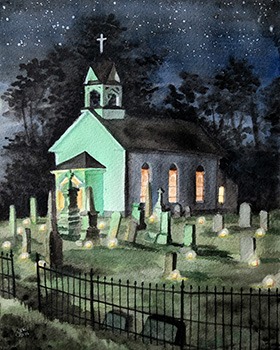
The desire for a proper church had been with the immigrants since their arrival. In 1830 John Hyland and Patrick Sullivan donated the land for the church and cemetery, without cost. In 1833, the deed was signed to Bishop Hughes, Albany, in the log cabin home of Mrs. Abby Healy, who was the official witness. As the church was built right across the street from Abby’s home, she would, until she died, welcome and feed visiting priests. The church, a small white wooden building with a steeple capped by a cross, stands today with its guardians of ancient hard maple trees. And following the custom of another era, three-quarters of the grounds is a cemetery enclosed by an old wrought iron fence.
For the first few years after completing the church, Mass was celebrated three or four times a year. Twenty years later, St. Mary’s was designated a mission church, and Father Kenna, the first pastor of St. Patrick’s Church, Oneida, New York, was assigned to serve Mass. As years passed, St. Francis and St. Mary’s final pastor was Father Joseph Kehoe.
In the year 2000 the Dioceses of Syracuse, short of priests and funds, decided to close St. Mary’s. As the church was in dire need of repair, the same thought as our ancestors, the goal was to have a spiritual gathering place. Many of the past members of the church, relatives of the deceased and the local community joined together to raise funds for the repairs of the church.
St. Mary’s Cemetery Obituaries
James Brennan 1842-1883
Husband to Anna...
James D. Dunn 1903-1987
ONEIDA -- Douglas...
Thomas Mulhall 1828-1898
Hon. Thomas...
Leona Messenger 1915-1935
ROME -- A sister...
John Bolen 1864-1889
Age 25. He was a...
Thomas E. Tyrrell 1885-1962
Thomas E. Tyrell...
John Sullivan 1807-1883
John Sullivan's...
John Tyrrell 1846-1910
Well Known Canal...
Eleanor M. Hyland Shumard 1919-1987
VERNON - Mrs....
Ann Conlon Shortle 1827-1910
Oneida, Oct 7 --...
William Shortell 1821-1894
From Ireland....
Franciszka Borowiska 1894-1938
ROME, Mrs. Frances...
Josiah McNally 1884-1969
DURHAMVILLE -...
Francis Joseph Kennedy 1867-1938
DURHAMVILLE -...
Michael Bolen 1818-?
Private 117 NY...
Frank Getman Dart 1872-1952
Frank Getman Dart,...
Nora A. Sullivan Kelly 1899-1967
MRS. NORA A. KELLY...
Elverton T. Hyland 1918-1987
DURHAMVILLE --...
John J. Heffron 1877-1899
WEEDSPORT, Nov 3...
Andrew H. Harrison 1860-1936
Oneida, June 16 --...
John A. Byrne 1869-1927
Detroit Man Dies...
William Wallace Wells 1860-1925
Rome Sentinel...
Patrick Cassidy 1828-1877
PATRICK CASSIDY...
James Tyrrell 1842-1906
HIGGINSVILLE Jan....
Rev. Edward J. Codd 1892-1939
Rome Sentinel...
Frank Brennan 1884-1920
Rome Sentinel...
Amanda V. Sullivan 1905-1940
ROME -- Miss...
George E. Sullivan 1901-1952
ONEIDA -- George...
William J. Ennis 1867-1912
William Ennis, 49,...
Henry Bird 1856-1931
Rome Sentinel...
Josiah A. Hyland 1848-1897
1848-1897
Abby Hyland Haley 1816-1910
ABIGAIL HALEY “LIVED SO NEAR RAILROAD YET SAW NO TRAIN”